Sunday, September 27, 2015

Remembering Dad on his 83rd Birthday

The following was my eulogy for Dad, nearly one year ago. I hesitated to post it, because it focuses on me and my brothers, but in the end, I think it is a good way to memorialize him:

Last time I did this, I balled like a little girl, so I had the foresight to have a relief pitcher [Jason Doty] in the bullpen, so if someone finishes for me, things are still going according to plan.

I'd venture to say not many knew my dad well; he was not incredibly social and enjoyed a certain amount of privacy. Many in attendance here today may actually know one of his sons much better. So, in preparing my remarks for today, I remembered something a good friend of mine, Lou, told me back in DC - "Mark, you have to have kids, because they are the key to your immortality." So, I told him, "fine, find me a wife." But, upon further review, I think the best way to memorialize my dad may be in the lives of his sons. If you have truly made your mark on people - on who they are - you have bestowed a unique and magnificent gift to the world. I have believed for some time now that the definition of a man is he who lives his life for someone else… as a father, a husband, in the military… etc. Therefore, it is appropriate to remember Gary Porter specifically for what he gave his sons.

Let's start with me (Mark): One of Dad's great joys was feeding us and our friends; I have been feeding people for half of my life in 17 different restaurants, on international trips, and in my own home. Dad coached baseball and soccer for decades; I have continued that tradition in soccer and football. Dad taught that persistence pays, and you should always delight in others; these lessons are key to who I am.

Throughout Dad's treatment for cancer, his optimism seldom wavered; anyone who knows Brian would agree his optimism borders on recklessness. I think his motto in the tank in Iraq was, "What could possibly go wrong?" Brian is a dedicated father who used to fly Alicia out to San Bernardino from Arizona for weekends not just to uphold his duty, but because he wanted to be an active participant in his daughter's life; Dad was the same way. Brian stands up for what he believes, sometimes a bit too vigorously, as in the case of the "Celebrities Incident" with the bouncer; Dad took his employer to court - and won - to put his foot down for racial equality. Brian has lived a life of service as a builder of things - houses, office buildings… a casket - as well as in the US Marine Corps. Dad was a big believer in service as well.

Both Tom and Dad are known for their assertive natures. Neither can be said to have been shy about what they believed to be true. Tom and Dad have been historians, often reaching to the past to inform the present. Perhaps most important, Tom, in the past eight years has transformed into a father who celebrates his girls and strives to give them every opportunity this world allows (except riding public transportation). Dad, I'm sure, was quite proud.
Interestingly, all of Gary Porter's boys are conservative, hard-working, strong-willed, and have a certain philosophy of "what is understood doesn't need to be discussed."

So, when you see these things in the Porter Boys, know that Gary Porter did live for others, and he made his mark on the world through us. If we in turn live well and pass these things on to others, our dad will truly live forever.


Sunday, September 13, 2015

Many Hands in Kathmandu - Volunteer Life in Nepal

I didn't take a lot of photos in Kathmandu, but here are a few with my All Hands team.

Me and Ritika


Our Project Director Gary's Birthday

April Leaving Town

Very Proud of Our Creation

One of Our 50 Homes Hand-Overs


Nikki

Ready to Head Home

Kelly

Wire Team Crew and Beneficiary on My Last Day

Wednesday, August 12, 2015

Saree, Not Sari-Sari - Kathmandu, Nepal


We're not in the Philippines anymore. That seemed to be the theme of a conversation I had with a friend in Kathmandu I had met in Tacloban the other night. I haven't been here long enough to make any kind of judgments about this place, but it is certainly a different world. Philippines is far from perfect, as is my home country; it's not about perfection. As a long-term traveler, what we seek is a place in which we enjoy being. "Being" is the important word, because some places are stops along the way that draw no attachment, while others entice us to stay for a while and re-join normal life for some period of time. On these types of multi-country, multi-city journeys, life as you knew it mutates into a constant state of fluctuation - juggling sight-seeing with personal safety, cultural propriety, and your personal budget. If you can find a place where you can be your best photographer, writer, volunteer, honorary local, well, that's something unique.

Arriving at night is usually the worst way to do it. Bad things happen at night; it leaves you more vulnerable, and it's more difficult to find your way when you are your most ignorant of a new place. Luckily, I arranged for my hotel to send a driver to the airport. First impressions are always tough at night, because the morning light often produces a completely different scenario. Interestingly, my first impressions of Nepal started on the flight here. Several passengers had their cell phone cameras out shooting videos all over the plane - even up in the face of one of the flight attendants. The guy next to me stared conspicuously at my computer screen as I looked through some photos and tried to get some writing done. Seconds after landing, all of the seat belts on the aircraft clicked open, and everyone got up to open overhead bins at 100 mph. Upon arrival at the airport, the man processing my visa lied to me about not accepting credit cards before relenting. The man at the money exchange desk threw my ringgits back at me after I challenged him on the discrepancy between my receipt and the rupees I had received. It suffices to say, I was skeptical of what was going down in this country. It should also be said that in contrast, I encountered several people who were quite gracious and helpful - even forwardly friendly!

However, I know well enough that it requires some time to understand what is the truth of a particular location. It's not Tacloban, it's not Singapore, and it certainly isn't Lahaina. What is Kathmandu? We'll just have to wait and see, now won't we. For now, I'll just dodge the random spitting, try to find some water that isn't "processed" (maybe what is upsetting my stomach), watch to not get hit by cars and motorcycles on the wrong side of the street, and avoid the aggressive monkeys and vendors. Oh, yeah, and learn some Nepali. Stay tuned.


Wednesday, July 29, 2015

Blessed With Smiles in Tacloban - Discovering the Philippines

Sunset View from Our All Hands Volunteer Base in Tacloban
Blessed are the poor in spirit; the kingdom of heaven is theirs. Blessed are the patient; they shall inherit the land. Blessed are those who mourn; they shall be comforted. Blessed are those who hunger and thirst for holiness; they shall have their fill. Blessed are the merciful; they shall obtain mercy. Blessed are the clean of heart; they shall see God.
Matthew 5: 3-8

I won't pretend to be your travel guide to a small city you've never heard of in the Philippines. You're not going to go there. Truthfully, I may not have ever made it to the country if I hadn't been called upon to work there. This is not meant as a discourtesy, it simply had not been on my agenda. That being said, Tacloban, for me, was ultimately a profoundly charming residence for more than two months of my life.
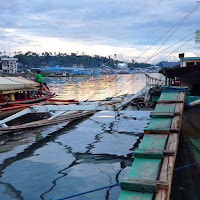
Downtown Tacloban by the Water
Situated in the northeast of the island of Leyte in the Eastern Visayas of central Philippines, Tacloban is neither terribly small nor relatively remote, having a population of about 200,000 and its own regional airport - comparable to my hometown, except you can actually use their airport (another story for another day). Tragically, in November of 2013, the powerful Typhoon Haiyan raged through Leyte and neighboring Samar. Violent wind and rain were followed by massive flooding, and deaths were in the thousands - official toll was 6,201, but estimates insist it was much worse.
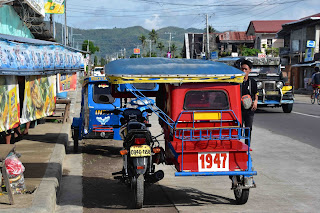


A "Trike" can sometimes transport up to six passengers
Eighteen months later, I arrived to contribute to
the rebuilding efforts already long underway by All Hands Volunteers. At first glance, this was a dusty seaside town bustling with small roadside shops, jeepneys and modified motorcycle taxis, and people of all ages walking to and fro. Bake shops, pineapple vendors, and mechanics were at work. Mothers were busy scrubbing the laundry in the dirt paths between modest homes of scrap metal and wood. The scent of coconut charcoal grilling pork and various chicken innards was everywhere. The city was certainly back on its feet to the extent that it was apparently no longer
a disaster zone. However, one should not make the mistake to think - as is so easily the conclusion after news of a disaster is lost in the long shadow of time - that all was back to normal.
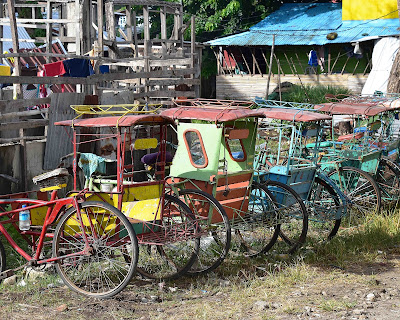
Pedicabs

But what is normal for these people? It was something to which I gave much thought while there. What did homes look like before the storm? Did people have different jobs that are no longer available? How many family members and neighbors exist now only in the memories of those remaining, leaving a void I will never feel? These are the questions I did not want to ask. Some volunteered information, but I imagined many had things they just didn't want to revisit. I can only tell you that life goes on despite the storm, but as evidenced in their stories, and even still referenced at church services, there is still great loss and a reality that cannot forget.


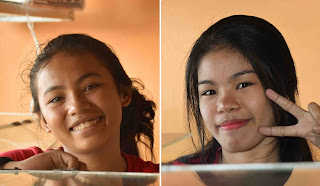
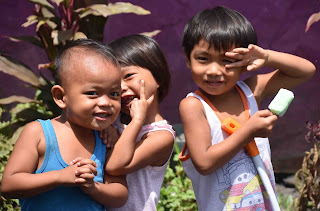
I was lucky to have met some fine people in the barangay (district) where I did most of my work as well as in other parts of the city. In getting to know them, I made some great discoveries without asking the invasive questions. One phenomenon I noticed during my stay was the magnificent smiles - from the kids walking to school, from the neighbors as I passed through from site to site, from the girls in the bake shop. Coming from a country and a life with so much, you realize just how silly "first world problems" really are in their proper perspective. However, still I considered - how is it that a people who have suffered through such a tragic event, many of whom seem to have very little, live with such delight and strength?

"God" has entered the discussion on more than one occasion. While many in my country seem to be trying their darndest to banish Him, I believe He may have sought refuge in the Philippines. Many Filipinos appear to be strengthened by their faith, and as a result, they feel blessed.

When Iries' eyes are smiling

Next, a word "content" appears to be quite relevant. My friend Iries explained to me that she is happy because she is content. The words appear similar, but they can be quite different. Her claim got me to thinking, because in my world back home, being content can be equated with lack of ambition. In the American model, one who is content will never break down barriers or accomplish the greatest heights. Content means letting grass grow under your feet. However, in the Philippine model, being content is the satisfaction of being grateful for what you have in life, rather than what you don't. Iries finds joy and contentment from being a mother. You can see it in her eyes, and it is the kind of happiness we should all be so lucky to have.
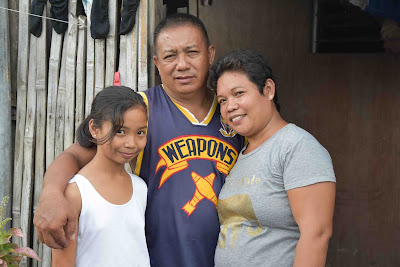

Susie (made me sisig!) with husband and daughter Jamie

Finally, back to the issue of "normal," I was fortunate to be invited into several homes during my stay - with a friend and her family, with people from the community in which we worked, and even in the home of strangers, just because I commented on hearing karaoke emanating from inside the house. In each instance, I was offered food and drink and was treated as a guest of honor. I think that must be normal for these people, and I like it! In my own experience inviting people into my home - even when I don't have much to offer - treating people to that level of esteem and offering a bit of yourself provides a special kind of dignity not easily found elsewhere.


The most difficult part of world travel is that you inevitably have to say goodbye to the people who help enchant your stay. Working in Tacloban is not your average construction site. Locals work alongside you, family members watch your work and sometimes bring you pancit noodles, baked goods, fruit, or cold soft drinks, and small children play all around where you are trying to carry heavy lumber and sacks of cement. We were a part of their world. They were what made ours bearable, and at times joyous. Thanks for opening your hearts and homes to us, friends of Tacloban. I wish you all the grace and happiness you deserve, that future storms pass you by, and that you always keep those magnificent smiles.
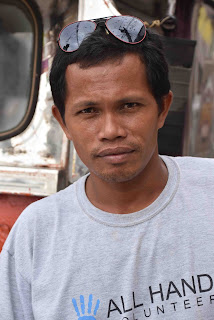
Allan! Jeepney driver and friend

Two of our lovely three bake shop girls


Hey, what's your name?!

Nancy and family hosted some great break-time meals

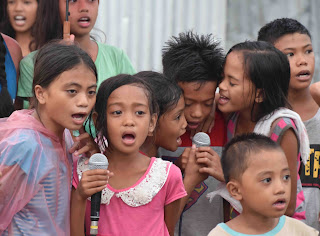
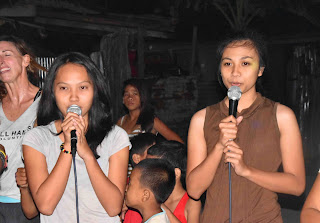
Kids from the barangay belting out the tunes

Gladiator Team attending the official hand-over of an All Hands home

Monaliza's voice was always music to my ears

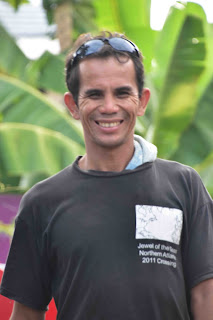
Melvin - one of our jeepney drivers and friend

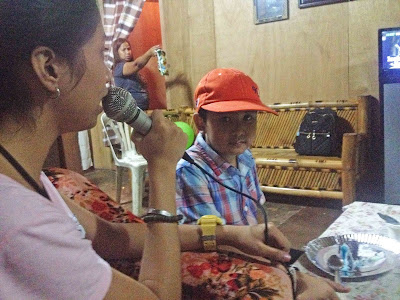
Josh's birthday, complete with videoke - I didn't know anyone there, but was ushered in to join the fun


To find out about All Hands Volunteers projects around the world, please visit:
www.hands.org

What I planned to say... - Goodbye Message from Project Leyte, Philippines

It was a long day. Indeed, it was a long stay in Tacloban and the Philippines - longer than anywhere I had stayed outside of the United States. It was the end of the meeting where departing volunteers share some sort of farewell with the crew. I had some wisdom planned to impart, but all I could muster was a thank you. Short and to the point? Yes, but here is what I wanted to say, more or less, to my friends of All Hands Volunteers - Project Leyte:
My first day here, I arrived and was put on the Gladiator team for work. As I rode off with the volunteers in the jeepney the next morning, I assumed I got the work nobody else wanted since I was the new guy - probably the hardest. It wasn't my first rodeo. It turns out I was right. Carl, Andre, and Bill seemed to be long term Gladiators who fed off of each other's competitive vibes, carrying heavier and heavier loads of sacks of gravel and sand, cement bags, and multiple pieces of lumber. Meanwhile, I was sweating profusely and probably suffering heat exhaustion. I had to stop and sit out for a bit - find the shade for a while to cool off. At the end of the day, I calculated at five weeks, six days a week, I was 1/30 of the way finished with my obligation - 29 more days of this. Maybe I should have gone on a food tour of Italy instead. Ha. The next morning was Bill's last day. One of the other volunteers, Izzy, decided to raise money for the project, she would cart Bill to work about five kilometers in a wheel barrel... and back at the end of the day! That night, I signed up to do dishes and consequently got first pick of next day's work. I said, "Gladiators."
Two and a half months later, people still ask me why in the world I chose to do it for almost my whole time on project. Most people get out their first chance and don't look back. Few of us stayed on as Gladiators to do the heavy lifting as suppliers for the rest of the teams. I suppose everyone comes to volunteer for their own reasons. Some want to bulk up their resumes with experience in line with their architecture or international development degrees. Others, perhaps, had just finished undergrad or high school and thought this would be a great experience to go and do good, maybe even meet some other cool young people, drink some beers, and just have a great time. Still others, no doubt, are world travelers trying to stay out away from home for as long as possible, and this serves well to accomplish that goal. I can relate to all of those motives, but there is something else.
Time and time again, the people of typhoon-ravaged Philippines have been referred to as "victims" and that we were here to help them. They are not victims; the victims are in Heaven. The victims needed the first responders and doctors. The people of Tacloban and surrounding areas don't need help being victims. When you show up to work everyday, do you see people who cannot function without us? No. You see smiles and waves; business goes on and kids are going to school; people have food - even enough to share with us. No one is starving or asking for money. I see survivors. I see people, undeterred by destruction and misfortune, living their lives content with what they have and moving forward. We are not here to save them; we are here to offer a service.
 I worked for twenty years in restaurants and hotels. My job title for much of this time was "Server," so you'd think I'd have mastered the idea. However, learning about service - true service to others - is often elusive even to those in the business. The first key to service is that IT'S NOT ABOUT YOU. Even in the service industry, this is easily forgotten, and we quickly revert to thinking about ourselves. The second key to service is that we are doing something exactly because it is NECESSARY AND GOOD. We are here to fulfill a need and because it is the right thing to do. Furthermore, we do no harm. Lastly, we recognize the need for SACRIFICE. True service to others is not using a hashtag for the cause of the moment or making a video of yourself pouring ice water on your head. Service requires something difficult from yourself. Service is hard.
Instinctively, we all know this to be true, and we all have proven to be service-minded or we wouldn't be here. However, like I said, even working in the business we need to have that focus, because it is very easy to stray. So, why do I choose to be a Gladiator? Well, because it needs to be done. It's hard, and that's fine.
 I will leave you with a quote from one of our favorite American actors - Tom Hanks, in A League of Their Own, responding to his player's reason for quitting is that "it just got too hard."
"It's supposed to be hard. If it wasn't hard, everyone would do it. The hard is what makes it great."
 Thank you all for your service.

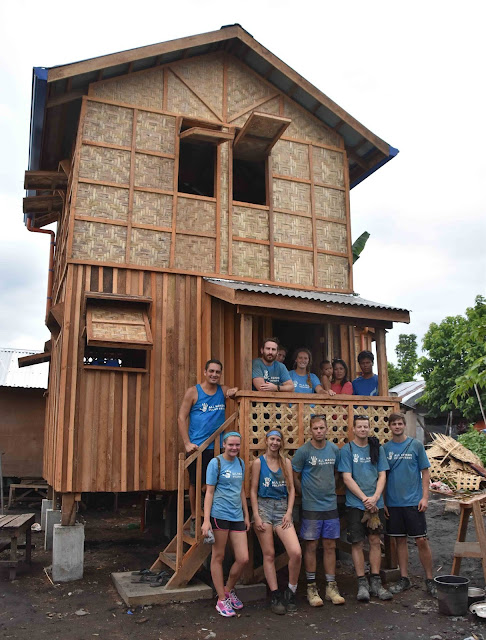
Volunteers in blue shirts posing with Filipinos near wooden homes

Friday, July 24, 2015

Island of Samar - Building Boats in the Philippines

Sunset in Pinabacdao
I was fortunate to be able to join the crew of my fellow All Hands Volunteers in Pinabacdao, on the island of Samar for four days. While I didn't do much to help build the boats for our beneficiary fishermen, I was on photography assignment, and this is some of what I was able to capture.

Find out more about what we do at: www.hands.org


Fisherman Walking to his Boat

Our Local Welcome Team in Calampong

All Hands Friends and Me on the Pier to Watch the Sunset

The Pier at Sunset in Pinabacdao


Veronique

Hand Stamp Signature as Finishing Touch

Many Hands Waterproofing the Hull
Proud Fisherman and His Boat

Monday, June 29, 2015

FLIGHT 777

It is a morning flight, which generally means I'm still waking up. The air is not yet obnoxiously hot, as is sure to later be the case. We file into queue and make our way to the airplane across the tarmac. My fellow passengers have no faces, at least as far as I can see, which fails to disturb me, as my mind is preoccupied with thoughts of leaving, what I will be doing at my next destination, and of course following strict mental protocol for my boarding ritual. 


FLIGHT ATTENDANT
     Good morning, sir.(gestures for me to move swiftly to my seat)
     Welcome aboard.

MARK
(pats the plane twice for good luck)
     Salamat! (in the melodic way to which I have become accustomed)

I settle in my seat, trying to make sure I get everything where it is supposed to be stowed, almost narrowly achieving the goal of not spilling my coffee on myself or others in the process. It is comfortably cool in the cabin that is full by the time I look up to see if anyone else noticed that I just stained my shorts with hot coffee on two consecutive sips. I had some things on my mind, like the untimely death of my high school friend just days earlier and the wisdom of zigzagging around Asia just to make my way back to where I had already been (on a dwindling travel budget).

The mist shooting out from the ceiling looks eerily heavenly for the first time.

SAM PRACCHIA
(seated just to my left, shuffling excitedly, as if he had never flown before)
This is going to be a great flight! Don't you think?

This was an odd declaration for two reasons, 1) no one says that, and 2) Sam went to high school with me and hasn't been alive since the early to mid-'90s.
Looking curiously around the cabin now, I notice several other familiar faces.

DON BACHELIER
Mark! (typically castigating for no apparent reason) I thought you'd be in Haiti... eating mud pies, but instead you're here in ASIA (emphasized as a subtle racist observation). Does someone here have a couch you can sleep on? What happened to your "artist's" apartment? Too many parties, or did they realize you're a waiter?
MARK
Yes, Don. They found me out. I didn't expect I'd see you here. Are you lost?
DON BACHELIER
You could say that. I've been reading your blog. Are you trying to make a movie now? (sarcasm) You should do a scene with you trying to make "the perfect burger."
 MARK
Oh, yes, like that time you set me up to compete with some of the best chefs in Washington?
 DON BACHELIER
The buns were perfect. I heard you singing at my funeral; I thought maybe you'd break out into a little Journey while you were at it...
I am suddenly jabbed in the ribs with two pointed fingers from two seats over to my left. It's the girl I met just a week before the beginning of Eighth Grade - a hyper sort with long curly hair and a wicked sense of humor.

CARRIE HAGMAN
Hey Mark! You sing Journey? Let's hear some. I didn't know you sing.
MARK
Usually only in a karaoke or otherwise protected private late-night setting. It was after your time. Can you keep your hands to yourself?
KENDRA MAY
(popping up from the seat behind)
Coach, how come you never sang for us? You just read us poems!
MARK
I'm not sure that would have been beneficial. I suppose you know the weather up ahead. Will we be landing on time today?
KENDRA MAY
Light winds from the east, but overall, should be a smooth ride. 
Across the aisle, one row up on my right, a young woman with long straight brown hair, and red lipstick turns around, pouring a glass of wine almost effortlessly.
PAM JOHNSTON
Hey! Have a glass with me! (freckles, bright smile, and a playful confidence)  Well, a plastic cup, anyway. Cheers!
MARK
Well, I wouldn't want to be rude... Don, would you like a cup? 
DON BACHELIER
OH, NO! (he dissented)
Don gestured to the floor - positioned discreetly yet obtainably next to his right foot on the floor was a bottle of cheap bourbon.

SAM MOELLER
I'll take a glass of red wine! (my uncle enthusiastically proclaims from two or three rows up on the left)
Sam chuckles, and you can see the glee through his glasses at the prospect. I just then notice my grandma in the middle seat next to him, cradling a two day-old baby girl. Grandma turns just about 45 degrees so I can see her eye brilliant with happiness, but her attention is proudly focused on her first and only granddaughter who is delightedly comfortable and oddly doesn't even seem to know how to cry .

Curiously, I survey the rest of the aircraft in search of other familiar faces: my first high school football coach is up on the right, not really noticing me, as usual; Dr. Godfrey, Mr. Bonadiman, Mr. Tafflinger, Mr. Lopez, Mrs. Kilgore are all scattered throughout; Ty's mom, Phil's mom, and Kevin's mom all are seated together - having just met, become fast friends. Joan Doty seems to already know everybody.

Then, two or three rows up on the right aisle seat is a gentleman consolidating his plastic containers from the various in-flight meal items for himself and the two passengers to his right into a neat stack waiting to be collected. His hair is buzzed short, and he is wearing his favorite collared shirt and comfortable black sweatshorts. My dad, with alert, bright eyes, excited for the trip to come, turns to Sam.

GARY PORTER
Hey! I sure would like some of that wine too. Is that Burgundy? (the cheap jug wine, not the French appellation)
(Pam pours for both of them)
I thank you kindly! (stated with all the faculties of a healthy human adult male)
Sam and Dad clink their plastic cups and eagerly turn to face forward. Dad proceeds to chat it up with John Lehrack and Mr. Cisneros on his right. Sam shares a side-hug with Grandma.

PAM JOHNSTON
(turns to me and nervously whispers, almost embarrassed that maybe she brought the wrong wine)
It's Bordeaux! Is that going to be okay??
MARK
Yeah, I think that'll be fine. It's good to see you again, Pam. I'm sorry we never got those Double-Doubles from In-N-Out like I offered.
PAM JOHNSTON

(big, gracious smile)
Oh Mark, that's okay. I think I can get one where we're going.
I look out the window - all clouds, white, without a hint of blue - suddenly contemplating the prospective consequences of being on board a flight with all people who should no longer have a pulse. I'm a bit nervous, yet everyone around me couldn't have a care in the world. Not one frown nor one tear can be seen amongst this jovial crew of people who may have never met most of one another, but have some connection to my life. All are as happy as could be. Though I have missed many of them tremendously, I am pleased to see them getting on so well and so confident that their upcoming journey is cause for celebration.

As the cabin shakes, and I still see no sign of anything but clouds out the window, I tense up a bit, worrying that this ascent might not change trajectory and that I am the only one who doesn't remember dying.

PAM JOHNSTON
(grabs my hand)
Hey! Don't worry. We're dropping you off. You have a trip to finish.
MARK
Yes. Yes, I do.